
AI agents vs workflows: choose the right amount of autonomy
A fixed process and a tool-using agent solve different problems. Here is how to choose, with a practical support example.
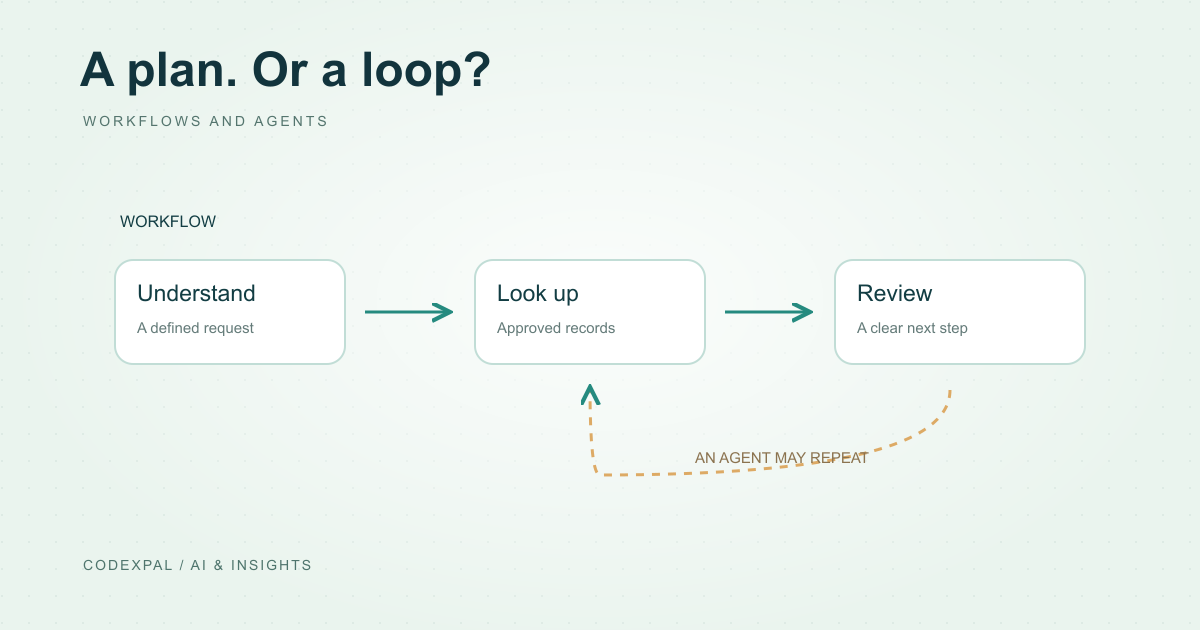
A useful automation does not need to be an autonomous agent. If every incoming support request follows the same known sequence, a workflow may be easier to explain, test and operate. An agent becomes interesting when the next useful action depends on what it finds along the way. The choice is about who controls the sequence, how much variation the task contains and which mistakes your application can tolerate.
Who chooses the next step?
In a workflow, application code defines the path. One step may call a language model to classify a message or draft a reply, but the program decides what follows. In an agent loop, a model can choose among available tools and use their results to decide what to do next. These are useful architectural distinctions, not guarantees about intelligence.
Anthropic describes workflows as predefined code paths and agents as systems in which models direct their own processes and tool use. A product can combine both: a fixed intake workflow may hand one difficult investigation to a bounded agent.
Reference: Anthropic — Building effective agents
Work through a support request
Consider a fictional request: “My order arrived, but one item is missing.” A workflow can identify the order number, fetch shipment records, compare the packed items and prepare a reply for a person to review. Missing identifiers can follow a defined clarification branch.
An agent might help when shipment records conflict with warehouse notes and the investigation has several possible paths. It could choose to inspect the parcel record, then search a packing note, then ask a clarifying question. The application should still decide whether the user may access that order and whether any proposed action is permitted.
A bounded investigation
- 01GoalInvestigate a missing item
- 02ChooseSelect an allowed lookup
- 03ObserveRead the tool result
- 04FinishEvidence or a handoff
Compare the operational tradeoffs
A fixed path gives you an explicit place to put validation, retries and human review. An agent adds flexibility, but also more possible paths, variable latency and harder-to-reproduce failures. Neither approach removes the need to handle an unavailable database or an ambiguous customer message.
Use the smallest design that can complete representative tasks. Before changing architecture, inspect whether your current failures come from missing data, a poorly described tool or unclear instructions. Adding a planning loop will not repair those problems automatically.
| Situation | Starting approach | Reason |
|---|---|---|
| Known steps and a stable output | Workflow | The process can be encoded directly |
| Uncertain investigation with several useful tools | Bounded agent | The next lookup depends on evidence |
| An action with meaningful consequences | Explicit review gate | Decision authority stays in application policy |
Keep authority outside the model
A read-only order lookup and an action that changes an order deserve different controls. Give tools narrow purposes, validate their arguments and scope credentials to the current user. A model’s suggested action is a request for the application to evaluate.
Set limits on elapsed time, tool calls and repeated failures. Record the evidence behind the final result. When the system cannot make progress, return a clear handoff rather than allowing it to loop or invent a resolution. Tool access should not silently expand because a prompt asks it to.
Reference: OWASP — Excessive agency
Test the outcome and the path
For the support example, test missing order numbers, duplicate products, contradictory records and a lookup that times out. Check that the final explanation matches the records and that the system never crosses into another customer’s data.
For an agent, also inspect the tools it called and whether it stopped at the right boundary. Compare the workflow and agent on the same cases, including cost and completion time. Keep the agent only if its added flexibility produces a useful improvement.
The takeaway
Choose a workflow when you can describe the process. Consider a bounded agent when the investigation genuinely needs a variable path. In both cases, permissions, budgets and meaningful review belong in the application.
Sources & further reading
Primary references checked on October 18, 2026. Examples and diagrams are illustrative unless stated otherwise.
More to think about.
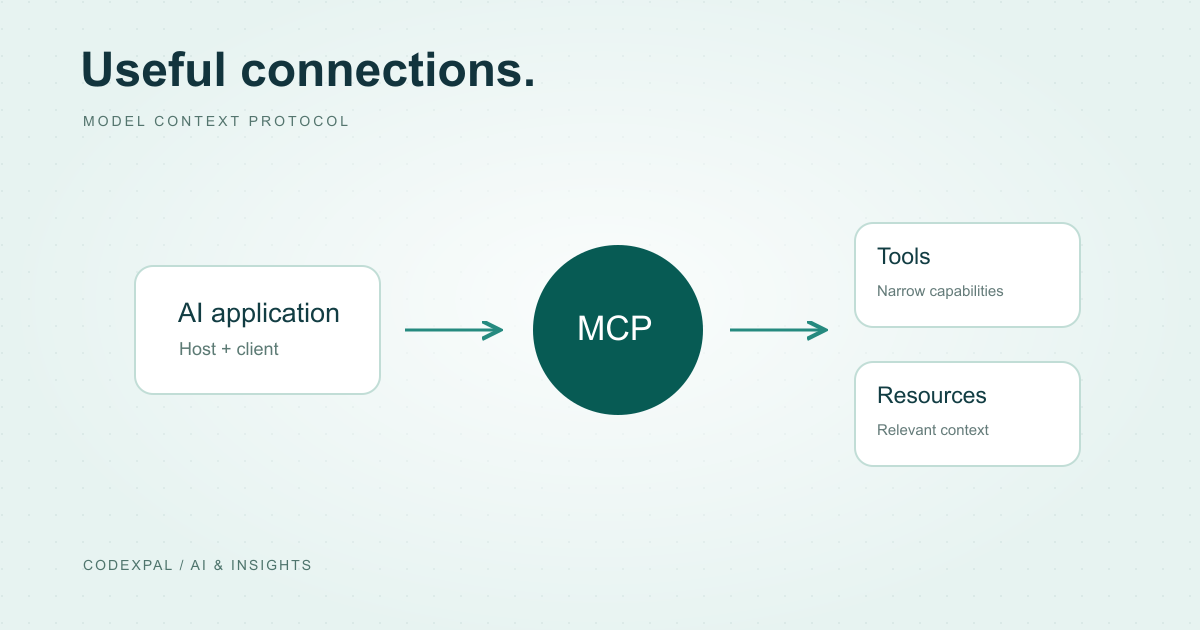
What is an MCP server? Tools, context and boundaries explained
Understand how an AI application connects to useful tools and information — and which responsibilities the protocol does not take over.
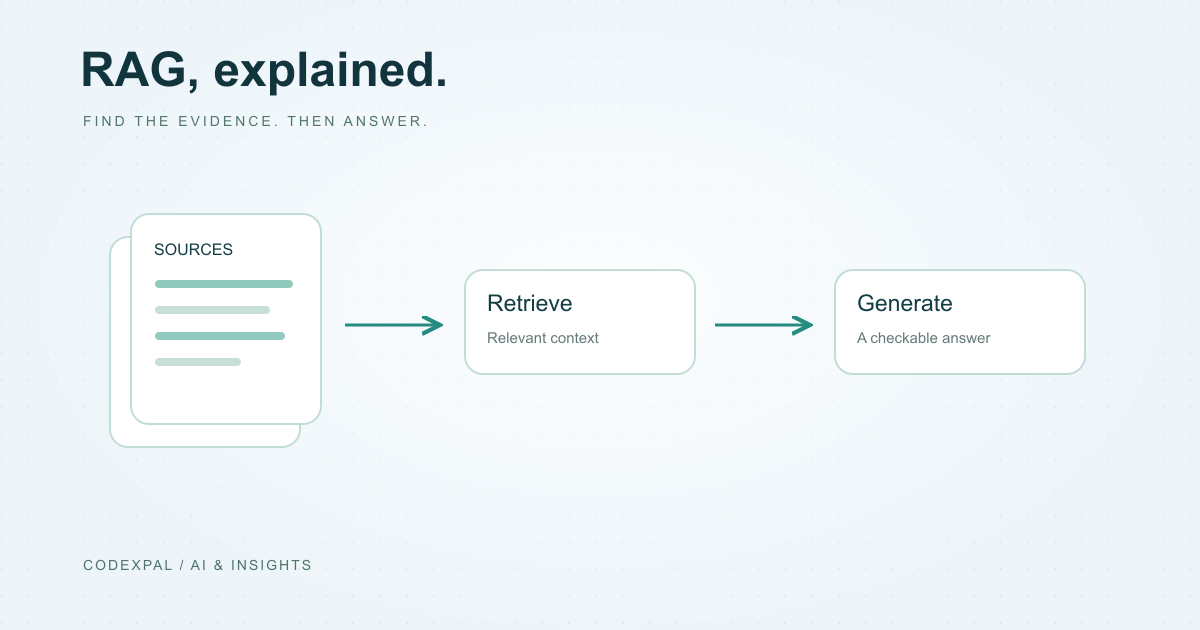
What is RAG? A practical guide with a simple diagram
How retrieval gives an AI application useful context — and how to build a small retrieval baseline before adding a vector database.