
How large language models work, without the mystery
Tokens, training, context and generation explained through a small support-assistant example — including where confident mistakes come from.
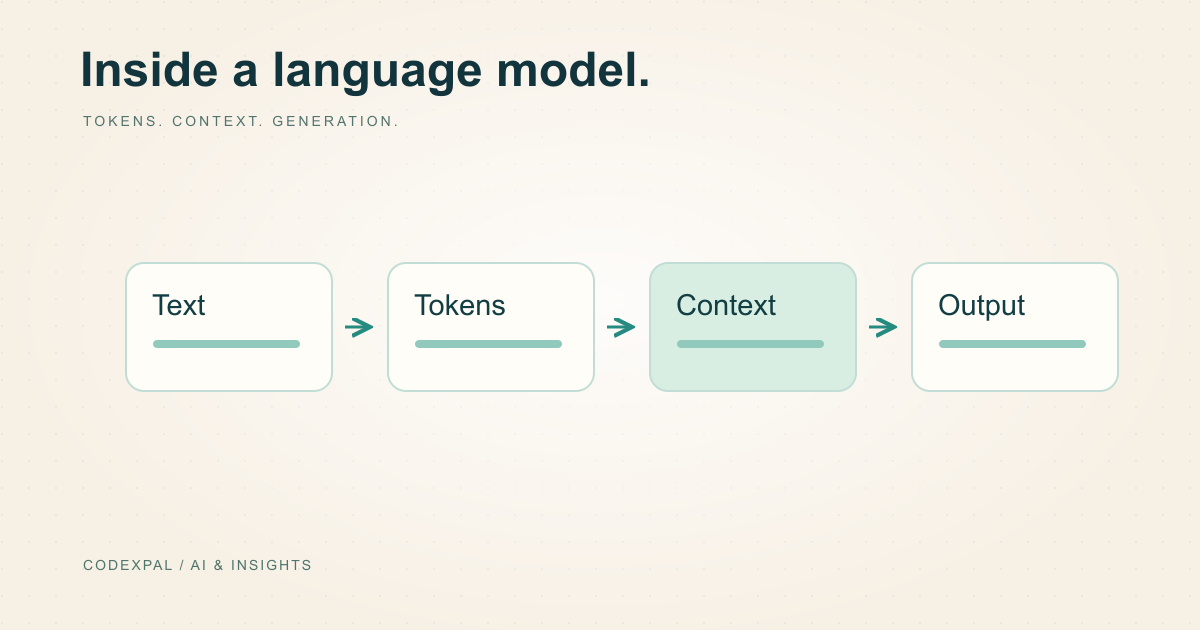
A large language model is a trained system that works with sequences of tokens. In a typical text-generation application, it predicts possible next tokens from the context it has received and produces a response one step at a time. That mechanism can support useful writing, coding and question-answering, but it does not automatically check whether every generated statement is true. Understanding the basic pipeline helps you build a better application around it.
Text becomes tokens
A tokenizer converts text into units represented by numerical IDs. A token may correspond to a word, a piece of a word, punctuation or another text fragment. The boundaries depend on the tokenizer; counting words is not an exact way to count model input.
This matters for multilingual products. Two sentences with similar meanings can use different numbers of tokens. A context limit is a limit on the model’s accepted sequence, not a promise that it will understand an arbitrarily long document. Measure actual token usage with the model or provider you choose.
Reference: Hugging Face LLM Course — Transformer models
Training learns patterns in sequences
During pretraining, many language models learn by predicting text from surrounding or preceding context. Their parameters are adjusted to reduce prediction error across training examples. Later training can make a model better at following instructions or producing responses people find useful.
Many current text generators use decoder-style Transformer architectures. Attention lets the system combine information from different positions in its context. The original Transformer paper introduced an attention-based sequence architecture; it did not describe every later language model or establish that attention is equivalent to human understanding.
Reference: Vaswani et al. — Attention Is All You Need
Context shapes the response you get
For an illustrative support assistant, the context might contain an instruction to be concise, a customer’s question and a short approved delivery policy. The model can use all of these when generating its next tokens. Information that your application never supplied cannot be relied on as if it were present.
Long conversations also need deliberate management. If earlier details are removed or summarized, an important condition may disappear. Keep essential identifiers and authoritative facts in application state, then supply the relevant pieces for the current task.
A simplified generation pipeline
- 01InputInstructions and user context
- 02TokenizeConvert text into token IDs
- 03PredictCompute possible next tokens
- 04DecodeBuild the response sequence
Plausible output can still be wrong
The model can complete “Your parcel will arrive on…” with a plausible date even when no shipment record is available. A natural-sounding completion is not the same as an authenticated database result. The application must decide which questions require a lookup and how to handle missing evidence.
Changing sampling settings can alter output variability. It does not turn an unverified statement into a verified fact, and a low-temperature setting is not a guarantee of factual accuracy. For calculations and current records, prefer a deterministic function or a permitted tool.
Choose the surrounding system deliberately
If an answer needs your documents, consider retrieval. If a task needs an external action, expose a narrow tool and enforce its permissions. If the output must match a schema, validate it after generation and handle invalid output as a normal failure case.
A useful first experiment is to ask the same support question with an approved policy, without the policy and with a contradictory policy. Record how the model behaves, then decide how your application should constrain it. Keep the experiment small enough that you can inspect every answer.
| Need | Application responsibility |
|---|---|
| Current delivery status | Authenticated record lookup |
| A calculation | Deterministic computation |
| An explanation of a policy | Relevant evidence and answer review |
| A change to a customer record | Authorization and action validation |
The takeaway
Think in terms of input, context, generation and verification. A language model is a useful component, while the application remains responsible for supplying evidence, checking outputs and controlling actions.
Sources & further reading
Primary references checked on October 18, 2026. Examples and diagrams are illustrative unless stated otherwise.
More to think about.
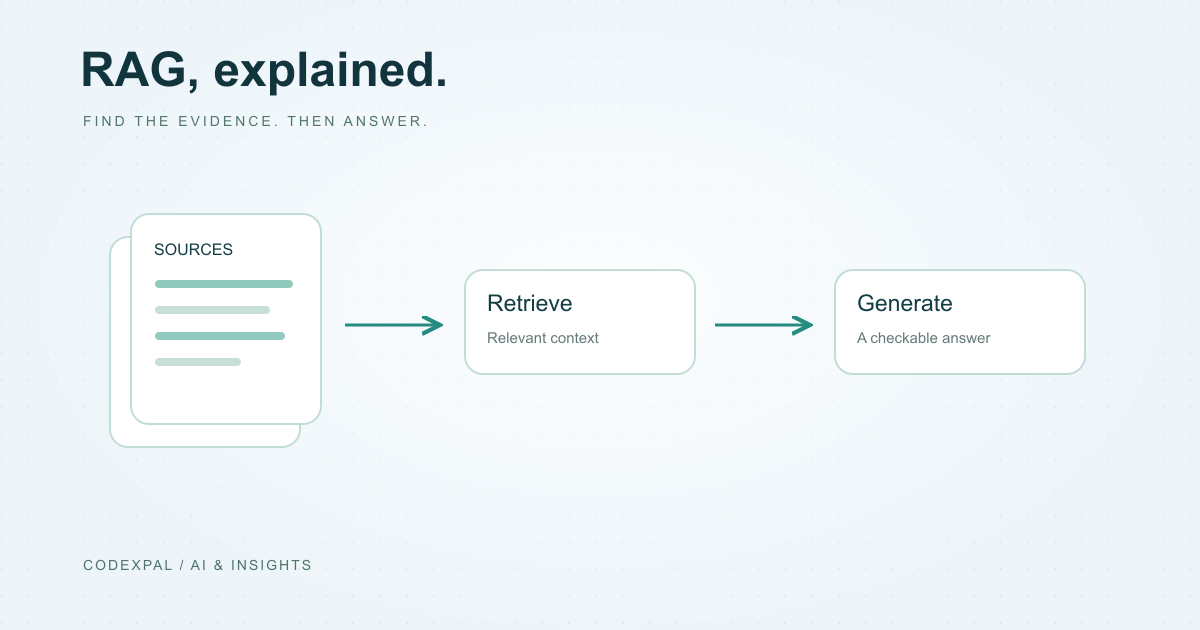
What is RAG? A practical guide with a simple diagram
How retrieval gives an AI application useful context — and how to build a small retrieval baseline before adding a vector database.
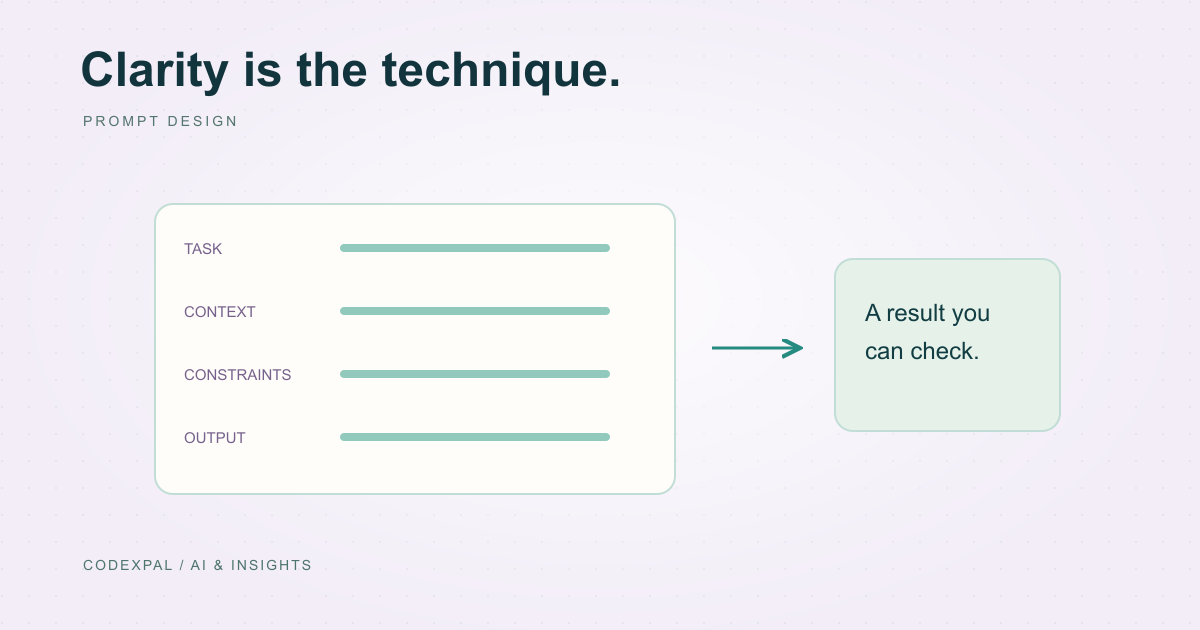
Practical prompt design: clear tasks, useful context, testable results
Replace magic phrases with a repeatable method for writing instructions, showing examples and checking whether a prompt improved.