
Practical AI for Nepali small businesses: start with one useful task
Choose an achievable first workflow, protect business data and measure the result before adding more automation.
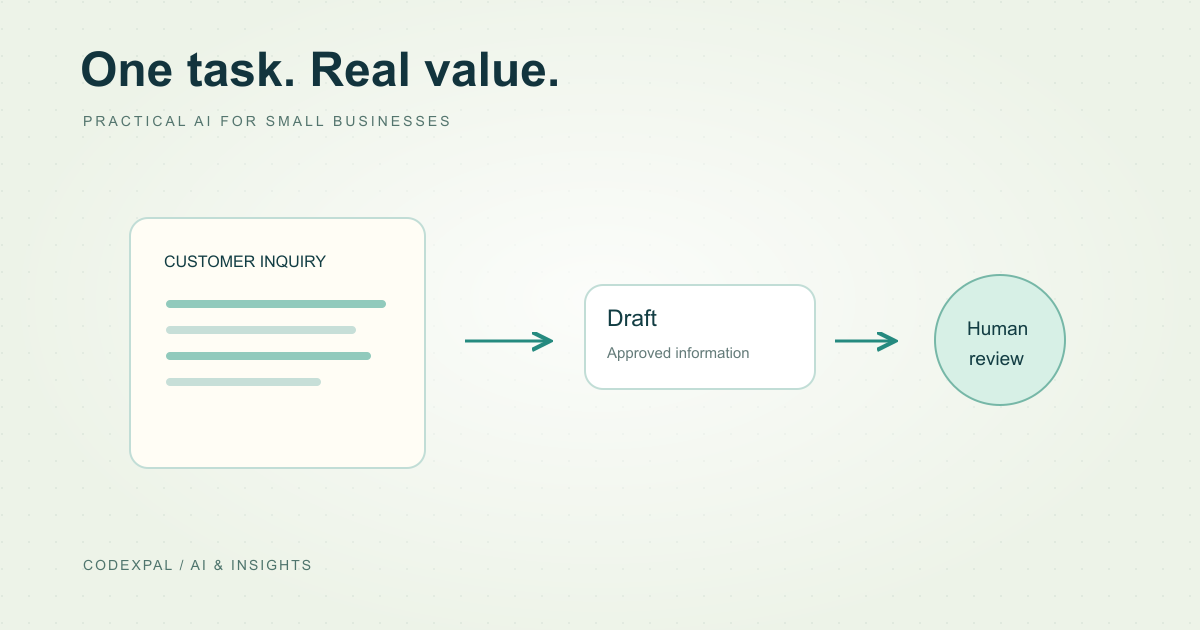
For a small business, the most useful AI project may be a modest one: turning an untidy inquiry into a draft reply, summarizing an approved product sheet or organizing a list of customer questions. Start with a task your team already understands. You should be able to explain the expected output, check it quickly and decide whether the result is worth the effort of running the system.
Map one task before selecting a tool
Consider a fictional shop that receives product inquiries through several channels. Staff repeatedly read a message, identify the product, check current stock and write a reply. An assistant might organize the message and draft a response after a permitted stock lookup.
The stock system should remain the source of quantity and price. The assistant can help express those facts, but it should not invent a discount or decide that an unavailable item is in stock. Write down who checks the draft and what must happen before it reaches a customer.
Choose tasks with a short review loop
Good starting candidates include rewriting an approved notice in clearer language, summarizing a supplier document and grouping questions by topic. These tasks produce something a person can review before it changes a business record or reaches another person.
A first pilot should avoid handing the system broad authority to issue refunds, alter account balances or make binding promises. OWASP’s excessive-agency guidance explains why broad functionality and permissions create additional risk. Keep the scope proportional to the task.
| Task | Helpful AI role | Keep controlled |
|---|---|---|
| Product inquiry | Draft a reply from approved facts | Stock, price and final send |
| Supplier document | Summarize and flag missing fields | Original record and review |
| Repeated questions | Group topics for the team | Access to customer details |
| Inventory arithmetic | Explain a verified report | Calculations and source records |
Reference: OWASP — Excessive agency
Prepare a small, clean information set
Collect the approved product descriptions, current procedures and examples of a good answer. Remove personal data that the task does not need. Use fictional or anonymized messages while experimenting, and understand where any external service processes the information.
For a bilingual workflow, include the language your customers use: Devanagari, English and Romanized Nepali where relevant. Ask someone fluent in those forms to review meaning, quantities and tone. A polished translation can still misstate a product condition.
A manageable first pilot
- 01SelectOne repeated task
- 02PrepareApproved information
- 03ReviewA person checks the draft
- 04MeasureTime and useful results
Measure the whole job
Record how long the task takes today, including checking and correcting work. In the pilot, record the same steps plus any time spent preparing input, waiting for a response and fixing the output. Count drafts accepted with light editing separately from drafts that require a complete rewrite.
Also count failures. If the assistant saves writing time but adds more review work, the result may not be an improvement. Use the comparison to choose whether to change the task, improve the information or stop the pilot.
Expand only after the small workflow is useful
Once a draft-and-review process works, decide whether another integration would remove a real bottleneck. A narrow read-only connection to a catalog may be more useful than an elaborate autonomous agent. Agree on access, ownership and a fallback when the integration is unavailable.
If your core challenge is inconsistent records, improve the records first. Tools such as business software and document organization can make both everyday work and later AI experiments easier. AI should fit the workflow your team needs, with a clear person responsible for the result.
The takeaway
Pick one task, define a checkable output and compare the full workflow against today’s process. A small assistant that reliably helps your team is more valuable than a broad automation whose mistakes are hard to notice.
Sources & further reading
Primary references checked on October 18, 2026. Examples and diagrams are illustrative unless stated otherwise.
More to think about.
How to manage retail inventory: a practical starting system
Build a usable stock register, separate sales from adjustments, and use a simple replenishment worksheet before automating your shop.
From an offline shop to an online store: a practical roadmap
Separate being discovered from taking orders, accepting payments and fulfilling them. Start with one complete customer journey.