
Build a small vector search with Python and PostgreSQL
Understand pgvector with a disposable database, a tiny dataset and an explicit distinction between example vectors and real embeddings.
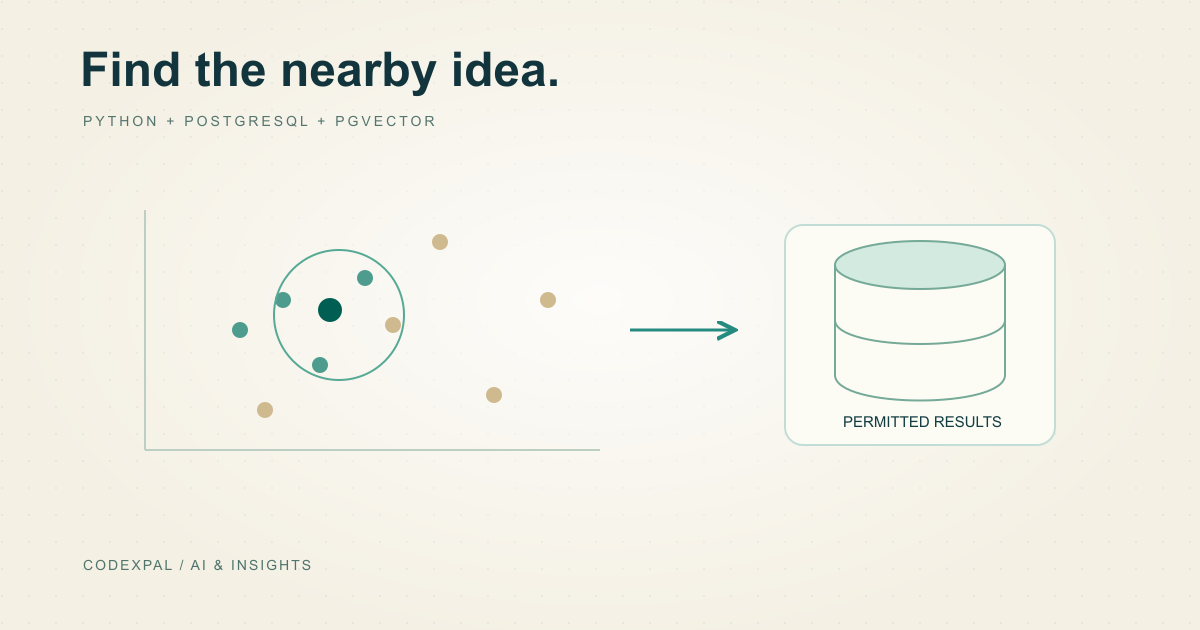
A vector search retrieves items whose numeric representations are close under a chosen distance measure. PostgreSQL with pgvector lets you keep those representations beside ordinary document metadata. Before connecting an embedding model or a generator, it helps to inspect a tiny example. This tutorial builds the retrieval layer only. Its three-dimensional vectors are invented for demonstration and are not meaningful language embeddings.
Prepare a disposable environment
Use a local PostgreSQL database with the pgvector extension installed on the server. Follow the pgvector project’s installation instructions for your environment, and make sure the database user can create the extension. Use a disposable database for the example, not an existing production database.
Install Psycopg with pip install "psycopg[binary]" in a virtual environment. Set DATABASE_URL in your shell to your local connection string. Keep credentials out of source control and browser code. The binary package is a convenient way to try the example; choose the appropriate installation method for your production environment.
Reference: pgvector — Official project and query examples · Psycopg — Installation
Create a tiny collection and query it
The Python 3 example creates a table named demo_chunks if it does not exist, adds two fictional records and retrieves one nearest neighbor using cosine distance. The primary key and conflict handling make repeated runs update the same example records instead of multiplying them.
Save it as search_demo.py and run python search_demo.py. With the configured database and extension available, the top result should be the returns record with distance 0. The query vector exactly matches that record’s invented vector. This proves the plumbing, not the quality of semantic search.
import os
import json
import psycopg

records = [
    ("returns", "Unopened items follow the returns policy.", [1, 0, 0]),
    ("shipping", "Delivery depends on the destination.", [0, 1, 0]),
]

with psycopg.connect(os.environ["DATABASE_URL"]) as conn:
    conn.execute("CREATE EXTENSION IF NOT EXISTS vector")
    conn.execute("""CREATE TABLE IF NOT EXISTS demo_chunks (
        id text PRIMARY KEY, body text NOT NULL,
        embedding vector(3) NOT NULL
    )""")
    for record_id, body, vector in records:
        conn.execute("""INSERT INTO demo_chunks VALUES (%s, %s, %s::vector)
            ON CONFLICT (id) DO UPDATE SET
            body = EXCLUDED.body, embedding = EXCLUDED.embedding""",
            (record_id, body, json.dumps(vector)))
    rows = conn.execute("""SELECT id, body, embedding <=> %s::vector AS distance
        FROM demo_chunks ORDER BY distance LIMIT 1""",
        (json.dumps([1, 0, 0]),)).fetchall()
    print(rows)
Replace the toy vectors deliberately
For semantic retrieval, generate each document embedding with the same model and preprocessing contract used for query embeddings. Match the table’s vector dimension to that model’s output. Changing models or dimensions usually requires a deliberate re-embedding and migration plan.
Store a stable source ID, document version and any access-control metadata beside each chunk. A vector is not enough to explain where a passage came from or whether the current user may read it. Keep the original source available for inspection.
The retrieval layer inside a RAG application
- 01PrepareText and source metadata
- 02EmbedA consistent model
- 03SearchDistance plus access scope
- 04ReturnPassages and source IDs
Begin with exact search and a baseline
pgvector performs exact nearest-neighbor search by default and also supports approximate indexes such as HNSW and IVFFlat. An approximate index introduces a speed-versus-recall tradeoff. It is not automatically necessary for a small document collection.
First compare retrieved source IDs against a small question set. If you later add an index, measure latency and recall on the same queries, including access filters. Use parameterized SQL as shown above and let the database enforce the application’s data boundaries.
Connect generation only after retrieval is useful
Pass a small set of relevant, permitted passages to your answer-generation step and preserve their source IDs. Define behavior for no useful match rather than always sending the nearest row as if it must be relevant.
Keep retrieval and answer evaluation separate. If the wrong passage appears, improve collection preparation or search. If the right evidence appears but the answer misstates it, work on the generation and validation step. This separation makes debugging much more concrete.
The takeaway
A small pgvector experiment can teach you how vectors, distances and metadata fit together. Move from toy data to real embeddings deliberately, evaluate retrieval quality and add generation only when the evidence selection is useful.
Sources & further reading
Primary references checked on October 18, 2026. Examples and diagrams are illustrative unless stated otherwise.
More to think about.
Build a local AI chat endpoint with Next.js and Ollama
A small server-side example with input validation, a timeout and clear errors — plus the steps needed before exposing it to users.

PHP2Shell and “Black October”: what AI-found vulnerabilities mean for every language
AI models helped find two unauthenticated remote-code-execution flaws in PHP’s core engine, the runtime behind up to 70% of websites. Attacks began within minutes. What happened, why npm and PyPI face the same pressure, and what every team should change.